Swabian Potato Salad Recipe (No Mayo, Beef Stock Dressing)
Last updated on October 13th, 2026
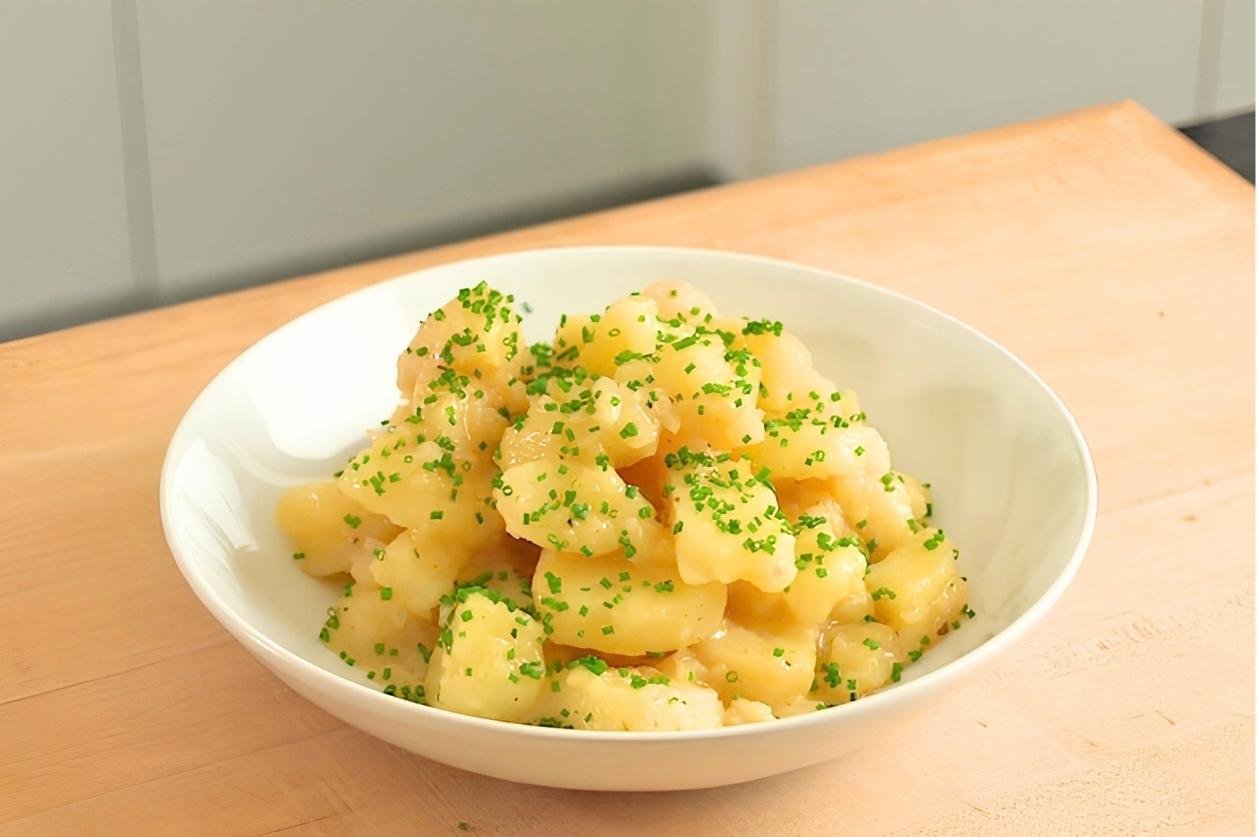
Swabian potato salad is a traditional potato salad from southern Germany, and it has no mayonnaise in it. Instead you make a hot dressing from onion, beef stock, white wine vinegar and mustard, pour it over warm potatoes and let them absorb it over two short rests. The potato starch thickens whatever is left, so the dressing clings to every piece.
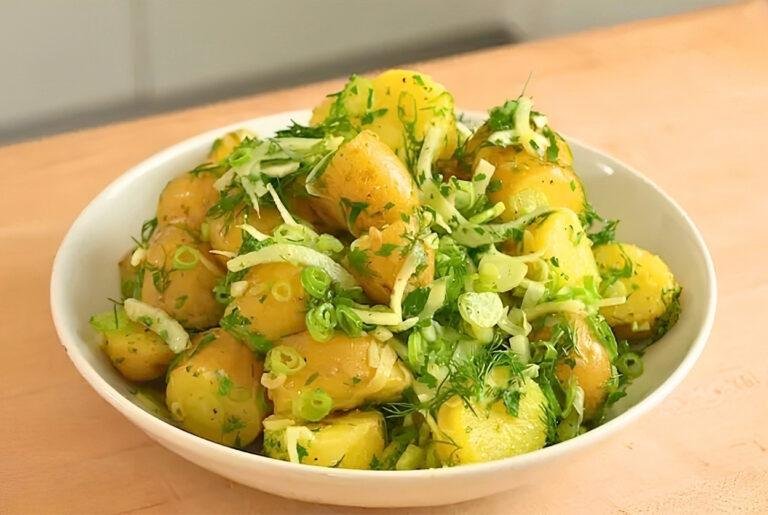
This recipe comes from the same video as my guide to why your potato salad is missing something and how to fix it, which covers texture, dressing and cooking potatoes just right. Of the two potato salads in that video, this is the one I would make. The other is my quick herbed potato salad with fennel.
Why You’ll Love This Swabian Potato Salad
- No mayonnaise: the dressing is hot and the potatoes soak it up.
- Savoury and balanced, not sweet. It is meaty and umami, lifted by the mustard, oil and vinegar.
- The potatoes keep some bite, and there is only a little oil in it.
- It lasts a few days in the fridge and gets better with time.
What Is Swabian Potato Salad?
Swabian potato salad is a traditional potato salad from southern Germany. Instead of mayonnaise it uses a hot dressing of onion, beef stock, white wine vinegar and mustard, poured over warm potatoes and finished with a little oil and chives. The potatoes absorb the dressing and their starch thickens it. This version is savoury, not sweet. In German it is called Schwäbischer Kartoffelsalat.
Swabian Potato Salad Recipe (No Mayo, Beef Stock Dressing)
Equipment
- Colander
- Mixing bowl / Bowl
- Chef’s knife
- Chopping board
- Digital scales
- Measuring jug
- Measuring spoons
- Saucepan
- Fork
- Spoon (table, dessert, tea)
Ingredients
- 1 kg waxy potatoes
- 1 onion finely diced
- 250 ml beef stock
- 4 tbsp white wine vinegar
- 2 tsp Dijon mustard
- 4 tbsp rapeseed oil or sunflower oil
- 1 bunch of chives
- Salt and pepper
Instructions
- Add 1kg of a waxy, fully grown variety of potato to a large saucepan, cover the potatoes with cold water and add a little salt.
- Cover with a lid and place on the stove over high heat.
- Once boiling, reduce to a very gentle simmer.
- Let the potatoes simmer for 20-30 minutes, depending on size.
- Meanwhile, finely dice 1 small brown onion (or use half a large white onion if needed).
- Add the diced onion to a small saucepan with the beef stock, the white wine vinegar and the Dijon mustard.
- Bring the mixture to a boil, then simmer for 1 minute to soften the onion and mellow the vinegar.
- Turn off the heat and cover the saucepan to keep the dressing hot.
- Check the potatoes – they should pierce easily with a knife, with slight resistance in the centre.
- Drain the potatoes, but keep them in the hot pan.
- Place the lid back on and let them finish cooking in the residual heat for about 20 minutes, until cool enough to handle.
- Once cool enough, scrape off the skins with a knife – they should come away easily.
- Cut the peeled potatoes into large, bite-sized pieces.
- Place the potatoes into a bowl.
- Pour the hot dressing over the warm potatoes.
- Mix gently but thoroughly.
- Cover the bowl and let sit for 15 minutes to let the flavours mingle.
- After 15 minutes, stir again – the dressing should begin to thicken.
- Leave for another 15 minutes to allow more dressing absorption.
- Stir once more – the potatoes should now be coated with a thickened dressing.
- Season with a little salt, cracked black pepper, and a few tablespoons of oil.
- Gently mix to emulsify the oil into the dressing.
- Serve with chopped chives sprinkled over the top.
Video
Nutrition
[bg-nutrition-label id=”8658″]
Ingredients You’ll Need
Use 1 kg of a large, fully grown waxy potato. There are thousands of varieties, so if it is not clear whether yours is waxy, floury or all-purpose when you are shopping, a quick search of the variety name is the fastest way to find out. If you want to see how waxy and floury potatoes behave, my roast potatoes method that works with any variety covers both ends of the scale.
The dressing is one finely diced brown onion (or half a large white onion), 250 ml of beef stock, 60 ml (4 tbsp) of white wine vinegar and 2 tsp of Dijon mustard. You also need a few tablespoons of rapeseed or sunflower oil to finish, chopped chives to serve, and salt and pepper.
How to Make Swabian Potato Salad
Cook the potatoes gently
Put the potatoes whole, with their skins on, into a large saucepan. Cover them with cold water, add a little salt, put the lid on and bring to the boil. Then turn it down to a very gentle simmer. The gentler the better, because that helps them cook through to the centre without breaking apart. Expect 20 to 30 minutes depending on size.
They are ready when a knife goes in with just a tiny bit of resistance in the middle. Drain them, put them back in the hot pan and put the lid on. The last 10% of the cooking happens in the dry heat of the pan, and with no water in there they cannot overcook. If you are short of time, just keep simmering them in the water until they are done.
Make the hot dressing
While the potatoes cook, put the onion, beef stock, white wine vinegar and Dijon mustard into a small saucepan. Bring it to the boil, then simmer for around a minute. That softens the onion and takes the harsh, acidic edge off the vinegar. Turn the heat off and put a lid on to keep it hot.
Dress the potatoes while warm, then rest twice
Once the potatoes are cool enough to handle, run a knife along the surface and the skin comes away easily. Cut them into large, bite-sized pieces and put them in a bowl. What matters here is that the potatoes are still warm and the dressing is hot. Cover them completely with the dressing and give a thorough but gentle mix. It looks a bit sloppy at this stage, but trust the process.
Cover the bowl and leave it for 15 minutes, then stir. The potatoes start absorbing the dressing and their starch thickens what is left. Leave it another 15 minutes. By then the potatoes have taken up most of the dressing and the rest has thickened enough to coat them.
Finish with oil and chives
Season with a little salt and cracked black pepper, then add a few tablespoons of oil at the most. Give it one last gentle mix to emulsify the oil into the dressing. You do not need to be vigorous, it happens easily. Serve with chopped chives on top.
Tips for the Best Swabian Potato Salad
- Keep the simmer as gentle as you can. Hard boiling breaks the potatoes up before they are cooked through.
- Dress the potatoes while they are warm, with the dressing hot. Cold potatoes will not absorb it the same way.
- Do not worry if a few pieces break down. That is what thickens and emulsifies the dressing, and the rest of the potato still has some bite.
- Do not skip the two rests. They are where the loose dressing turns into one that clings.
Storage and Make Ahead
This keeps in the fridge for a few days and gets better with time. Tomorrow it will be better than today, the next day a touch better again, and that is about the limit. If you are making it ahead, leave the chives off until you serve.
Frequently Asked Questions
What is German potato salad made of?
This Swabian version is made from waxy potatoes, onion, beef stock, white wine vinegar, Dijon mustard, a little oil and chives. There is no mayonnaise in it.
What is the sauce for German potato salad?
Here it is a hot dressing of onion, beef stock, white wine vinegar and mustard, poured over warm potatoes. As the potatoes absorb it over two 15 minute rests, their starch thickens what is left, and a little oil stirred in at the end emulsifies it.
What is the difference between German potato salad and normal potato salad?
For this version, there is no mayonnaise. The dressing goes on hot and is absorbed by the potatoes, and the result is savoury and balanced rather than sweet.
Can you make German potato salad without bacon?
Yes, this recipe has none. The savoury, meaty, umami depth comes from the beef stock, lifted by the mustard, the oil and the acidity of the vinegar.
What is German potato salad called in German?
This Swabian version is called Schwäbischer Kartoffelsalat.