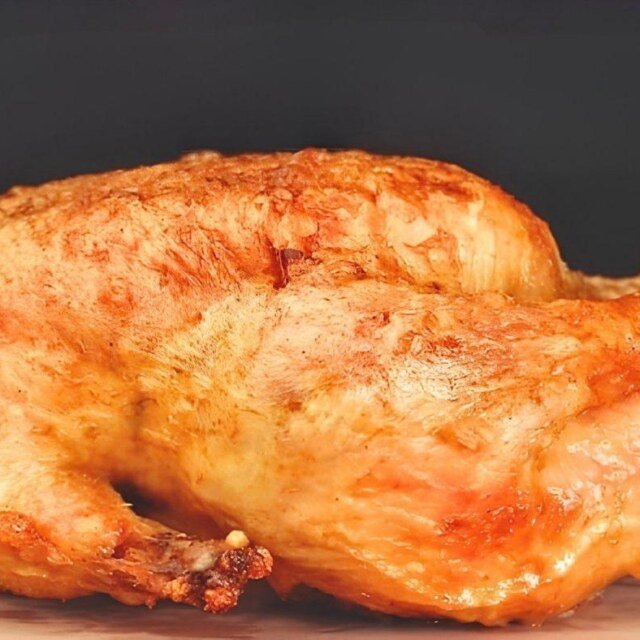
Best Way to Cook a Turkey: Juicy, With Cooking Times
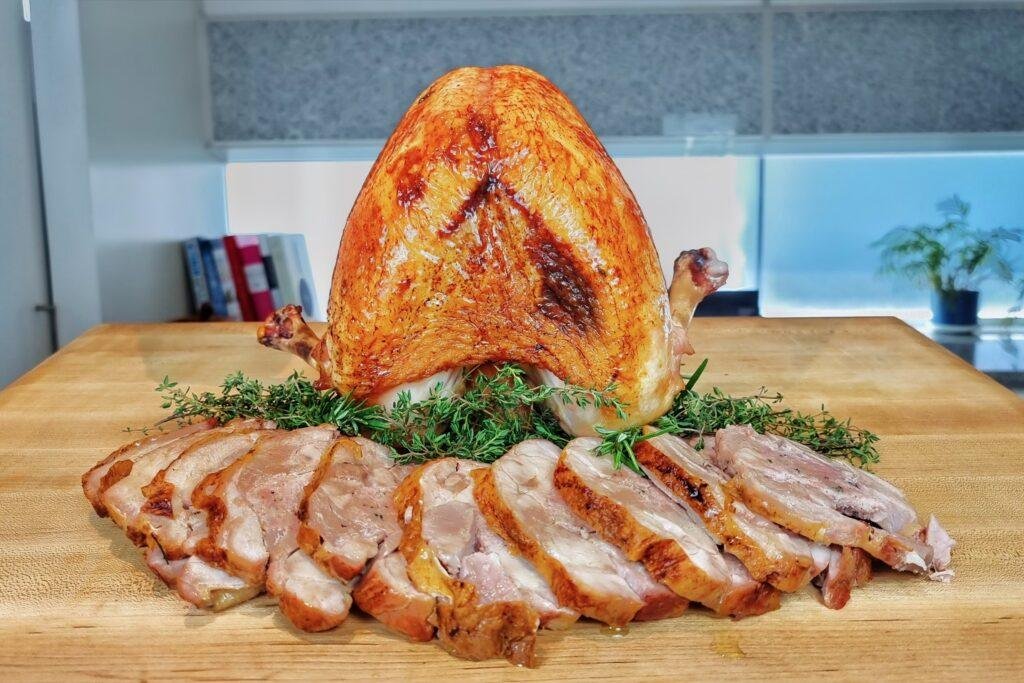
The best way to cook a turkey is to stop roasting it whole. After 20 years as a professional chef, I take the legs off, bone and stuff them, and roast them alongside the crown. The bird cooks for a lot less time, which gives you more tender, juicy meat, and most of the prep is done a few days ahead. Below is the full method, plus a cooking times table for any size of crown.
Why This Is the Best Way to Cook a Turkey
Breaking the turkey down is what makes the difference. A crown roasts in far less time than a whole bird, which gives you more tender, juicy, succulent meat. The bones you remove make a stock for gravy ahead of time, so Christmas Day is more relaxed.
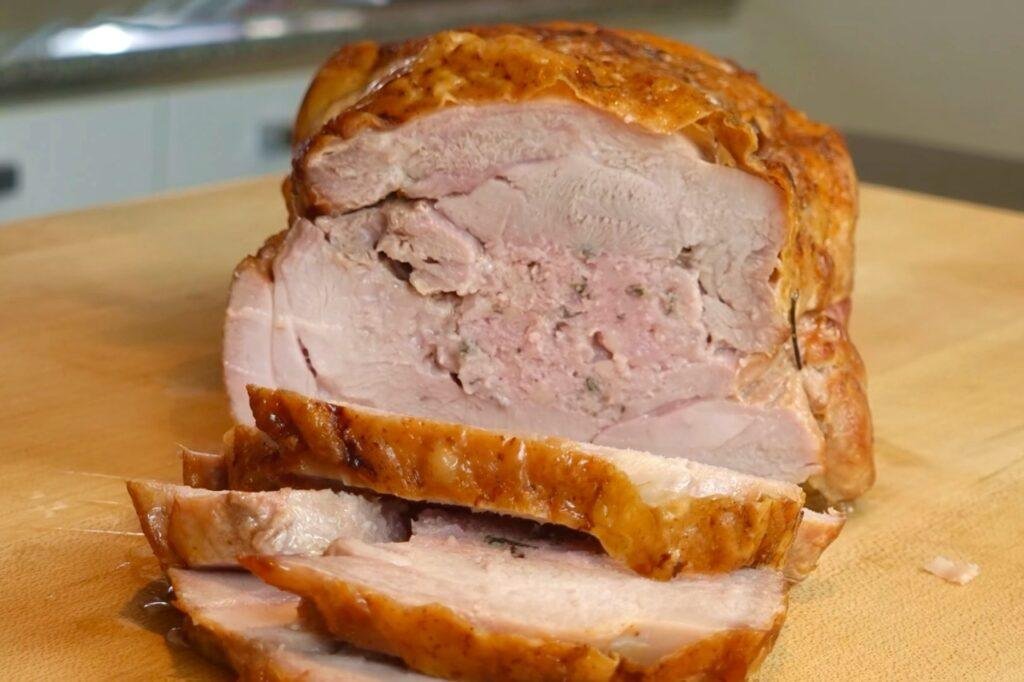
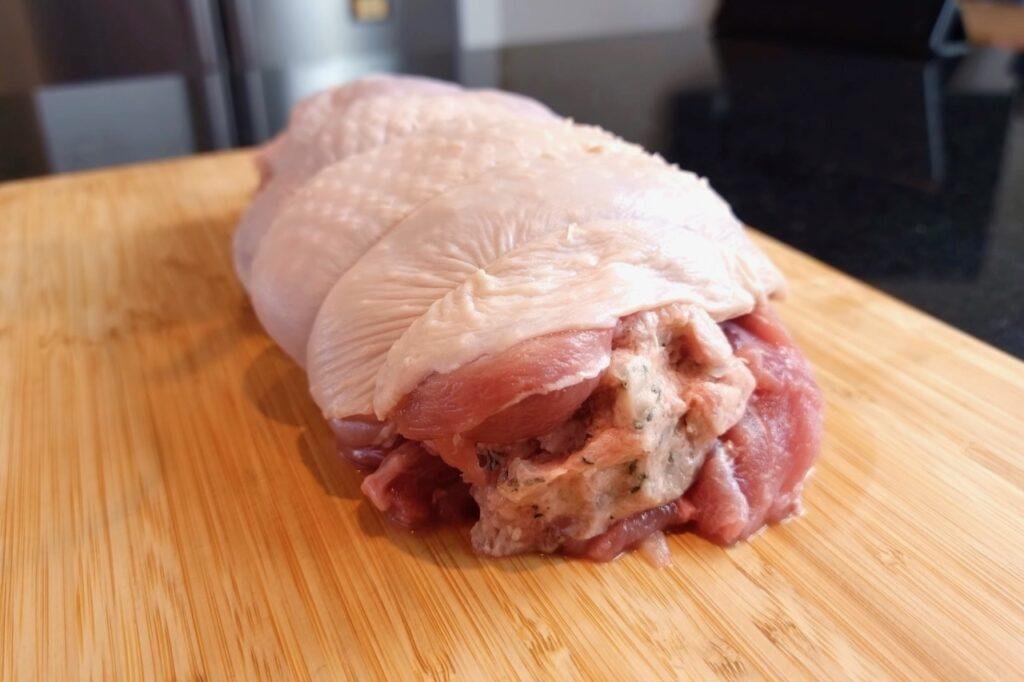
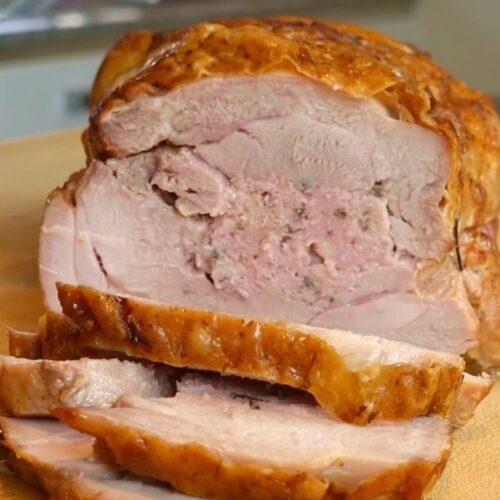
The legs are boned, filled with a seasoned pork stuffing and tied into one neat roll. Leg meat has some intramuscular fat, so it is far more forgiving than the breast. A dry brine seasons everything, and freeing the skin from the meat lets air in for a crisp, golden finish. A broken down turkey is also a lot easier to store in the fridge than a whole bird, so you are not clearing every shelf for three days.
Ingredients You’ll Need
You need a whole natural, unseasoned turkey. Mine was 6.5 kg (14.3 lb), which gave me a 2.5 kg (5.5 lb) crown and a stuffed leg roll, and this recipe serves 12.
For the turkey and dry brine
- 6.5 kg (14.3 lb) whole natural, unseasoned turkey
- 12 g salt, for the dry brine
- Cooking oil, for browning the leg
- 30 g butter, optional, for under the crown skin
For the stuffing
- 500 g (17.6 oz) 80/20 pork mince
- Half a white onion, finely diced
- 2 stems of sage
- A small bunch of thyme
- 2 tablespoons of breadcrumbs
- 1 g salt and 0.5 g black pepper
- 15 ml cooking oil, for sweating the onion
If you don’t eat pork, chicken or turkey mince works instead.
For the trivet
- 2 white onions, sliced into discs
- 3 carrots, sliced in half
- 2 celery sticks
- 2 stalks of rosemary
- 2 handfuls of thyme
For equipment you need a chopping board, a boning knife (or any non-serrated knife), a roasting tray, a frying pan, a mixing bowl, tongs, a serving spoon, a meat thermometer and oven-safe string. Oven-safe string is anything that is 100% cotton, uncoloured and unbleached.
How to Cook the Turkey
Everything up to the end of the brine can be done a few days ahead. My homemade cranberry sauce with orange and red wine keeps for a week or two in the fridge, so it can be made then too.
Make the Stuffing
Sweat the finely diced onion in the oil with a pinch of salt over a low heat until it is translucent and smells sweet, then cool it on a plate. Pick the sage leaves, roll them into a cigar and run your knife through them once only. Pull the thyme leaves from the stalks. Combine the pork mince, breadcrumbs, sage, thyme, cooled onion, salt and pepper, and mix gently, because rough handling toughens the meat.
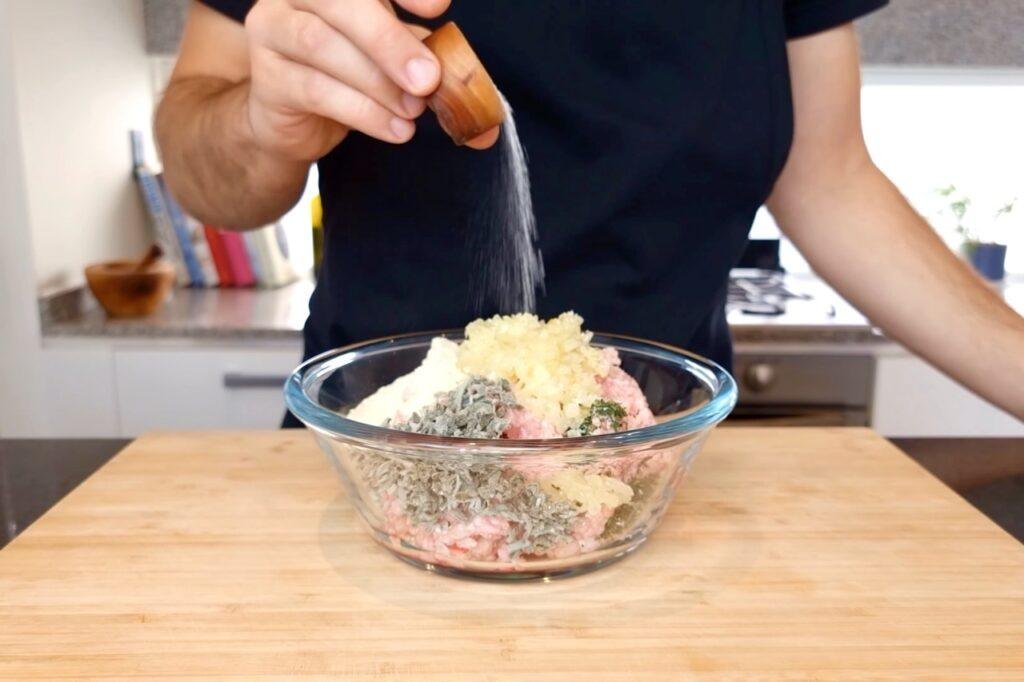
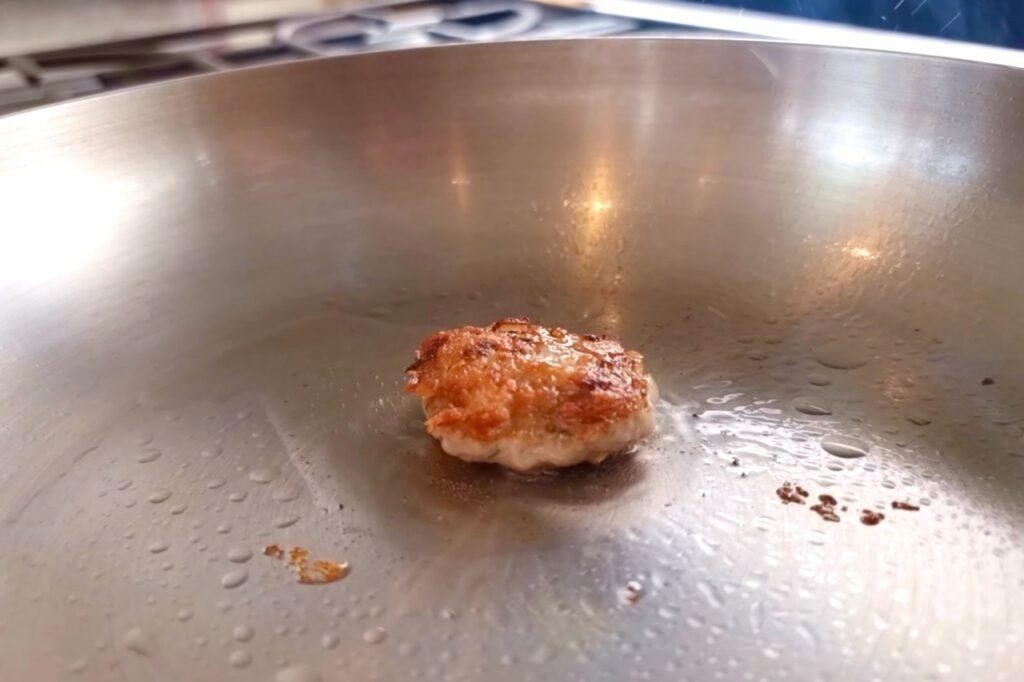
Fry a pinch of the mix as a mini burger for 2 minutes until cooked through, and taste it. Mine needed a touch more salt, and it is rare to get the seasoning right first time. Cover the bowl and chill it until you are ready to stuff the legs.
Bone and Stuff the Legs
Cut through the skin between the legs and the body, hold the turkey up by one leg and slice around the joint to take the whole leg off in one piece. Repeat with the other leg. If you want a closer look at taking a bird apart, my guide to how to butcher a chicken and every other type of bird works the same way for turkey.
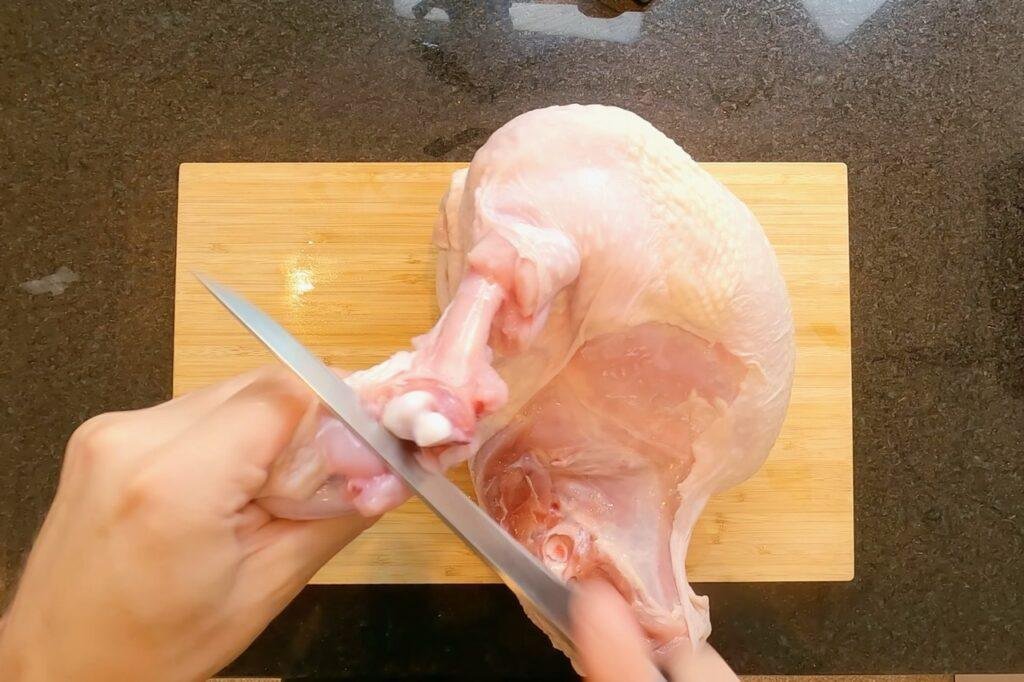
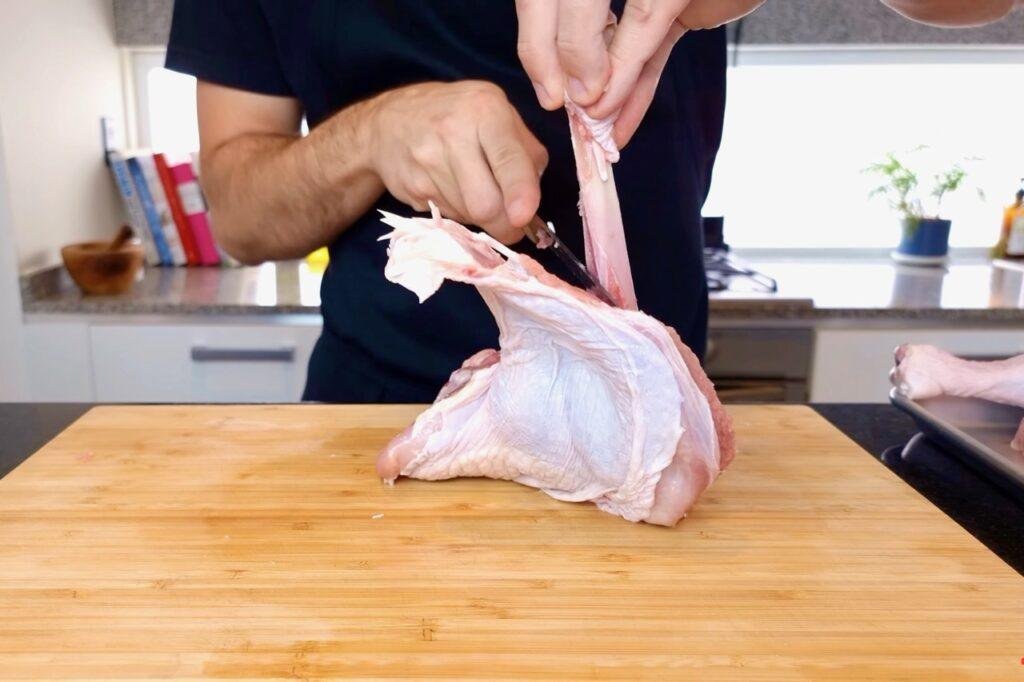
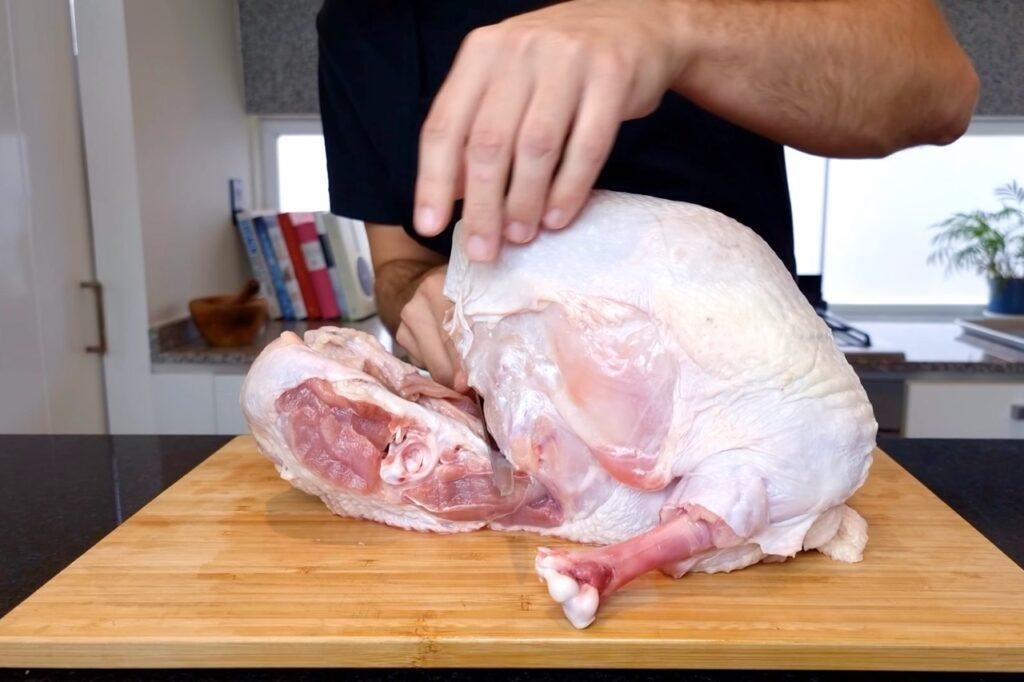
To bone each leg, lay it skin side down and slice along the two long bones until you hit bone, then work around them and cut the bones free. Remove any bone fragments, the cartilage around the knee joint (without cutting through the skin on the other side) and the thin, toothpick like bones in the drumstick.
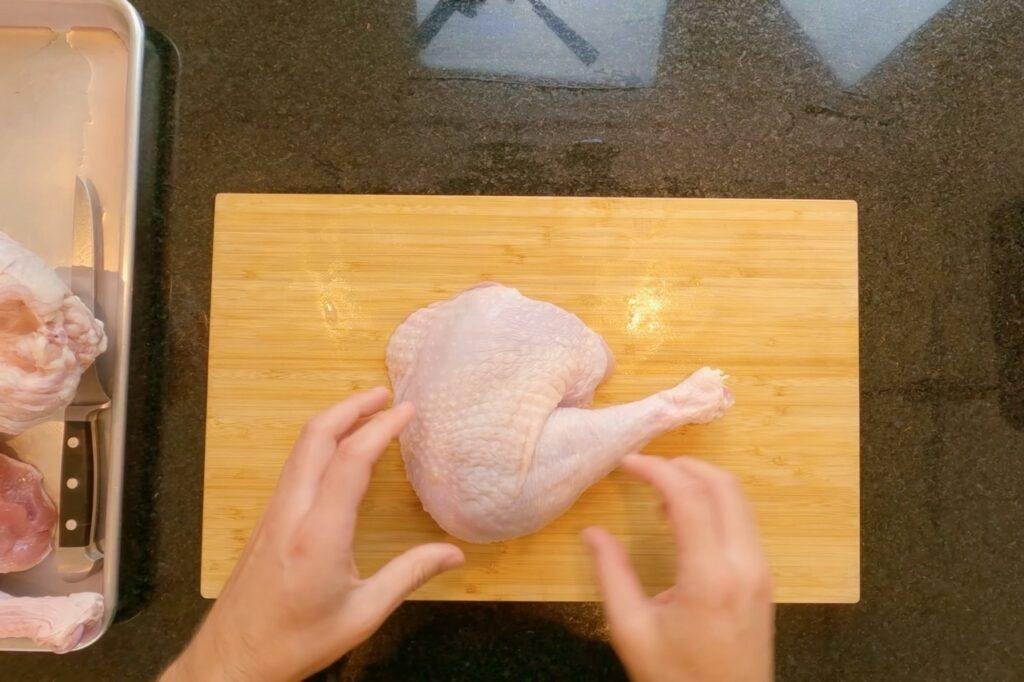
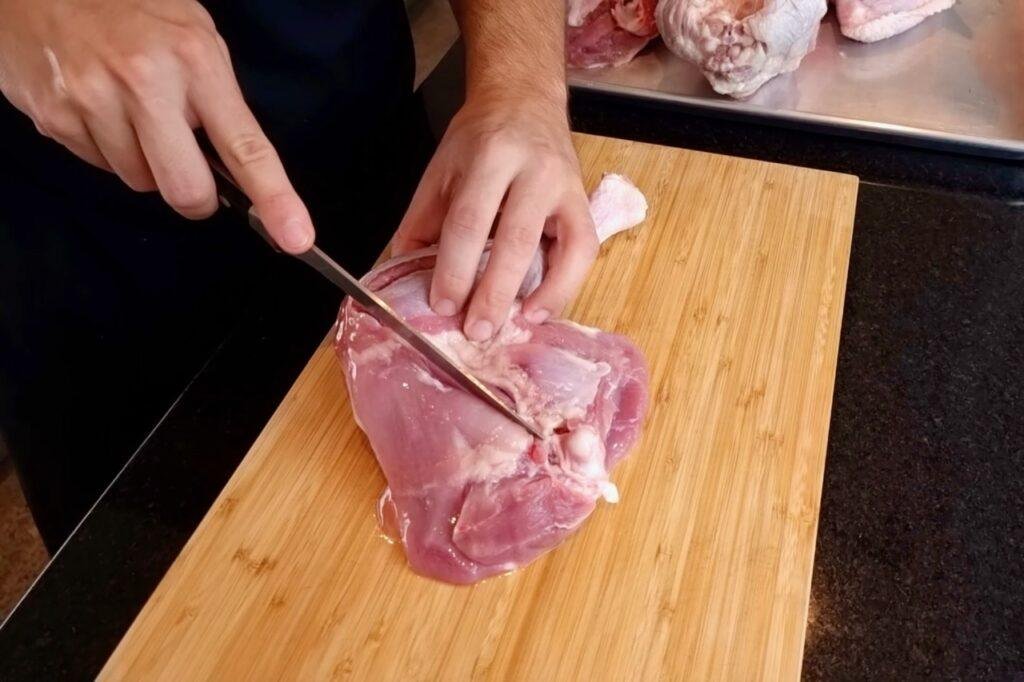
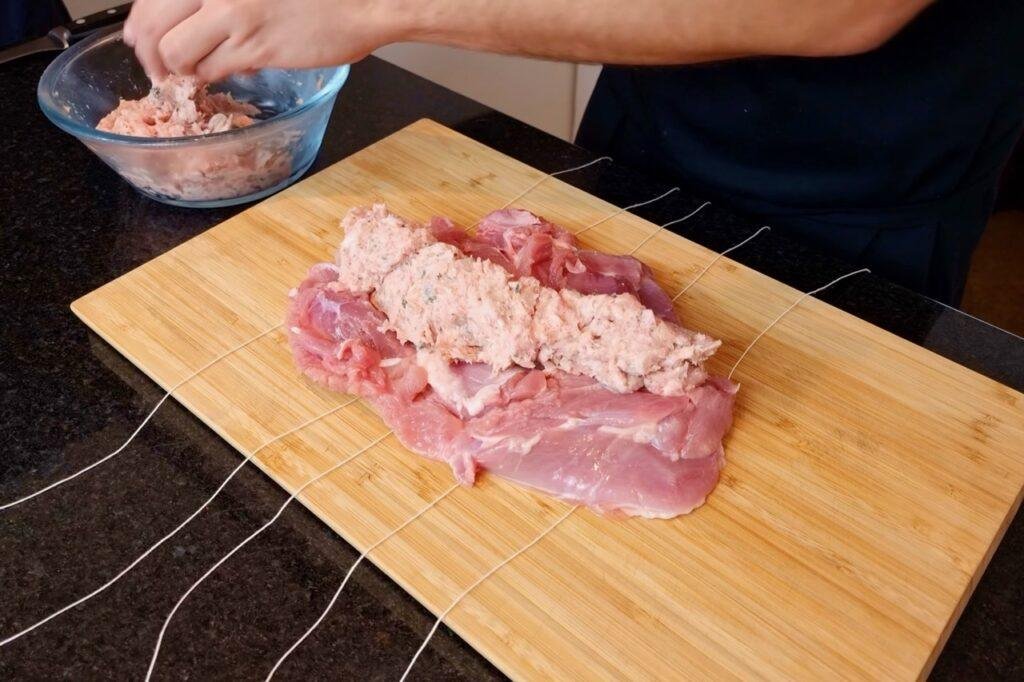
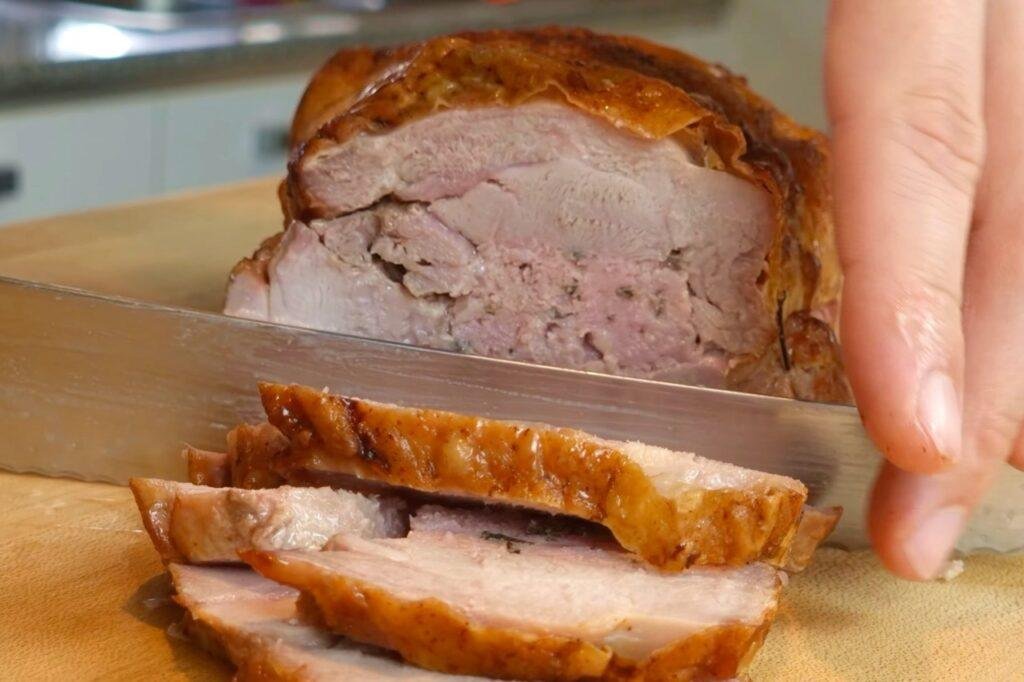
Lay five 50 cm (20 inch) lengths of string evenly spaced on a board. Put one leg on top with the widest part of the meat at the top, and slice out the highest point of the meat to fill the empty patch where the knee cartilage was. Lay the stuffing in a cylinder down the middle. Then place the second leg on top, skin side up, with its widest part at the opposite end, and shape the whole thing into an even cylinder.
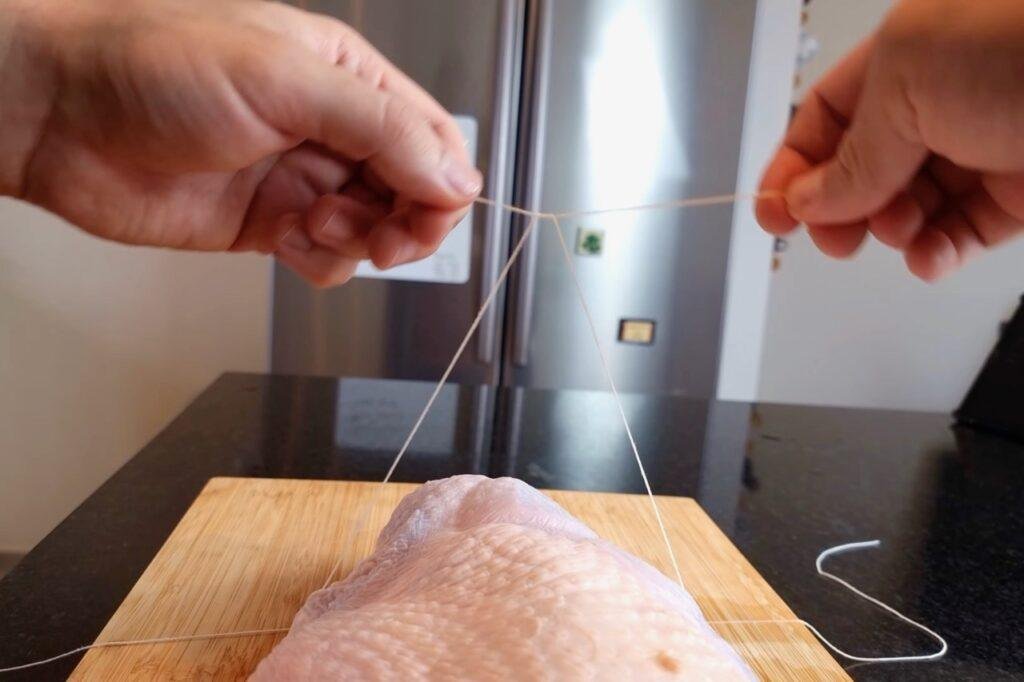
Tie the second piece of string first, then the fourth, third, first and fifth, which keeps the shape even. I use a left over right knot looped one extra time and pulled tight, then a second knot to lock it. Trim off the excess string.
Prepare the Crown
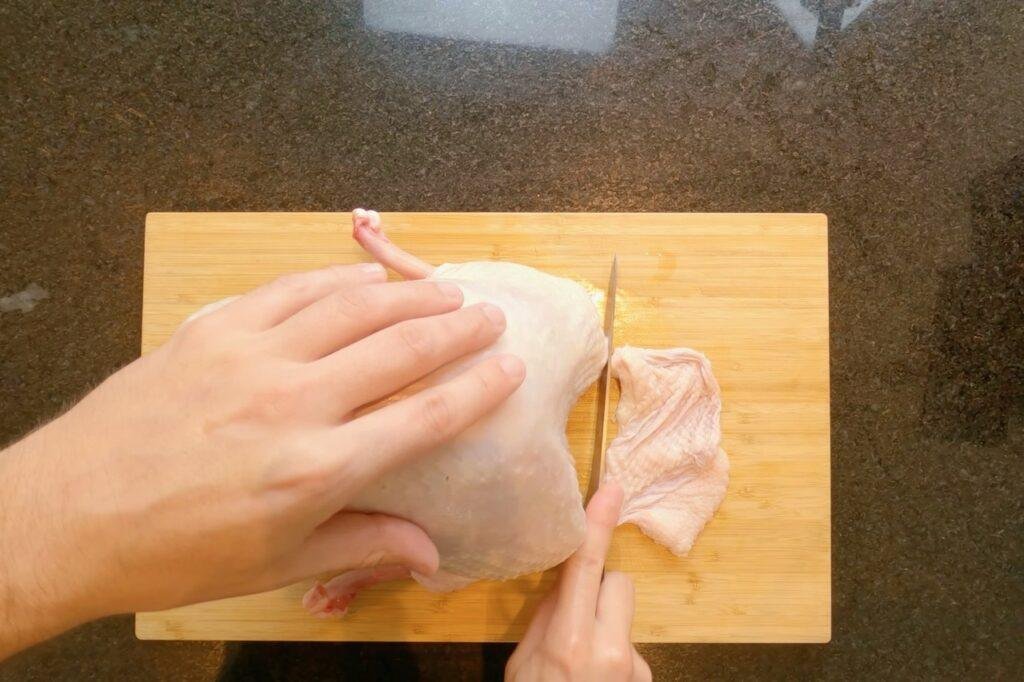
Hold the bird up by one wing and, halfway between the first wing joint and the joint on the body, slice and run the knife 360 degrees around the bone. Bend the wing back until the joint dislocates and comes free, then repeat on the other side. Turn the body 90 degrees and slice off the rear section by finding the gap in the spine and pushing the knife through. What is left is the crown. Keep the bones for a gravy stock. My make-ahead turkey gravy is built from exactly these bones, roasted hard and cooked into a stock overnight.
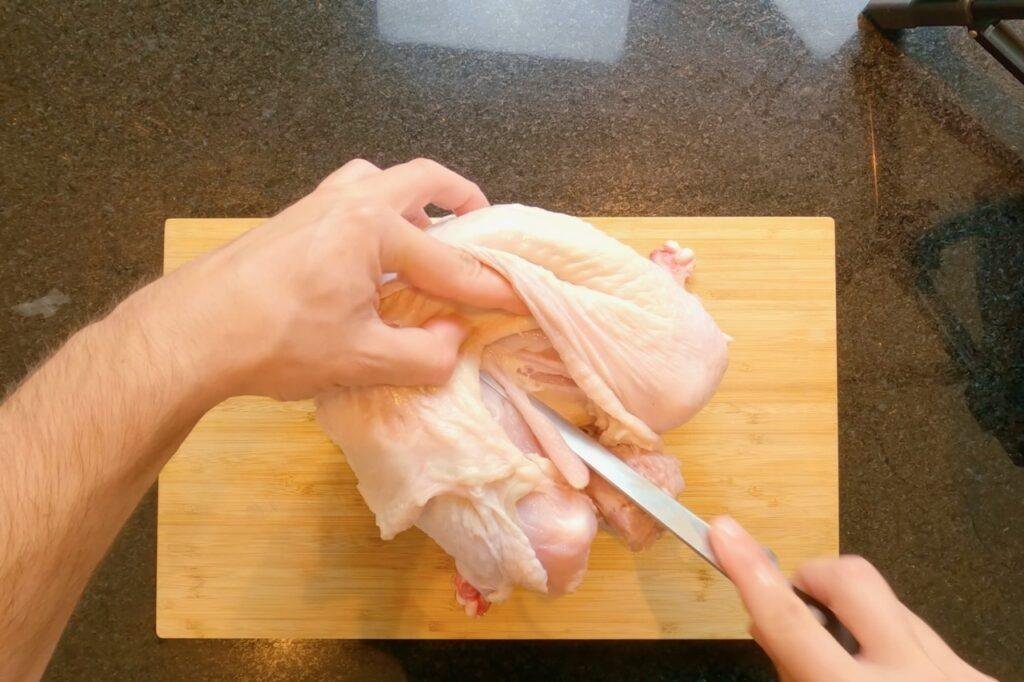
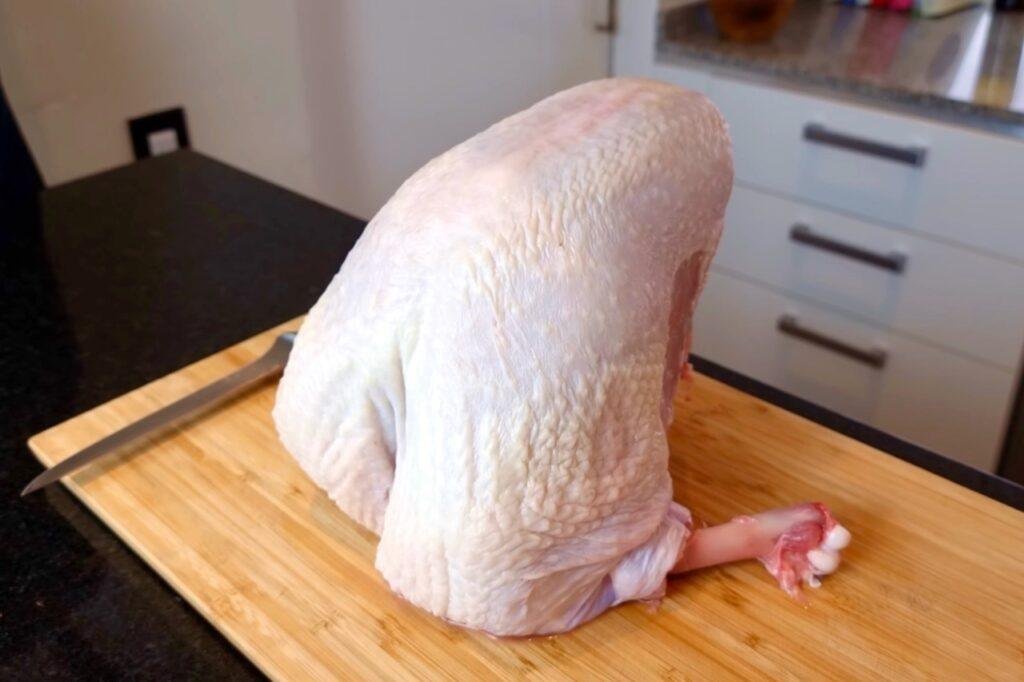
You can also remove the wishbone, which makes carving a lot easier. It is fiddly but worth doing. Pierce the knife in behind the bone on each side of the neck opening and cut down through it, slice up to where the two bones meet, then grip the bone and twist it free.
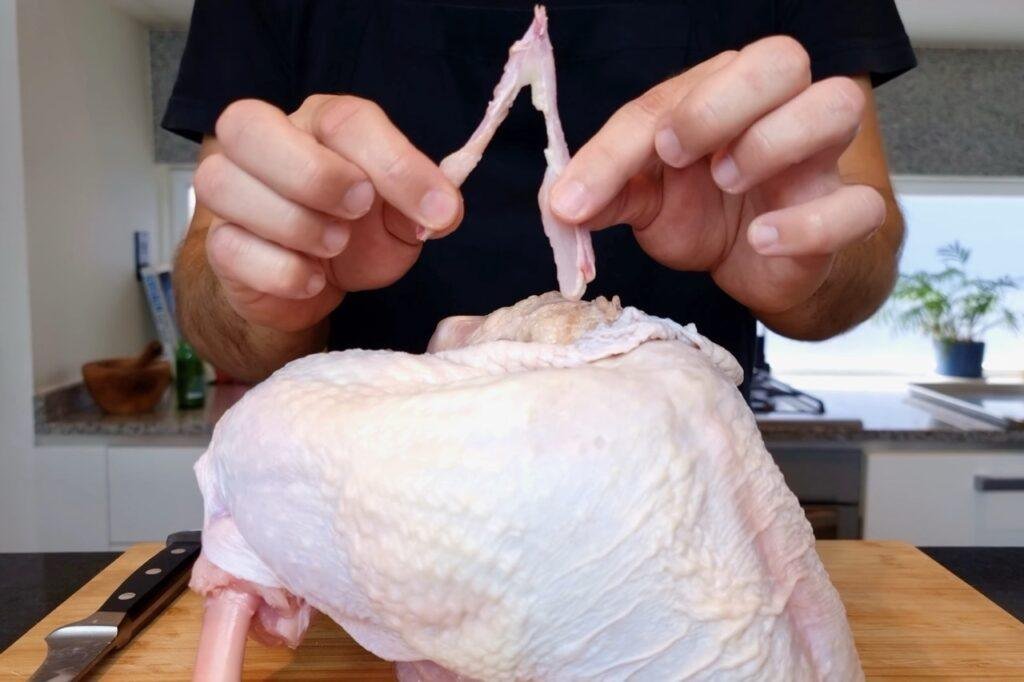
Finally, work your fingers in from the neck end and gently free the skin from the meat. The air gap gives you crisper, golden skin. Go slowly so you do not tear it, and trim off any excess skin at the neck end, leaving a little extra for shrinkage.
Dry Brine
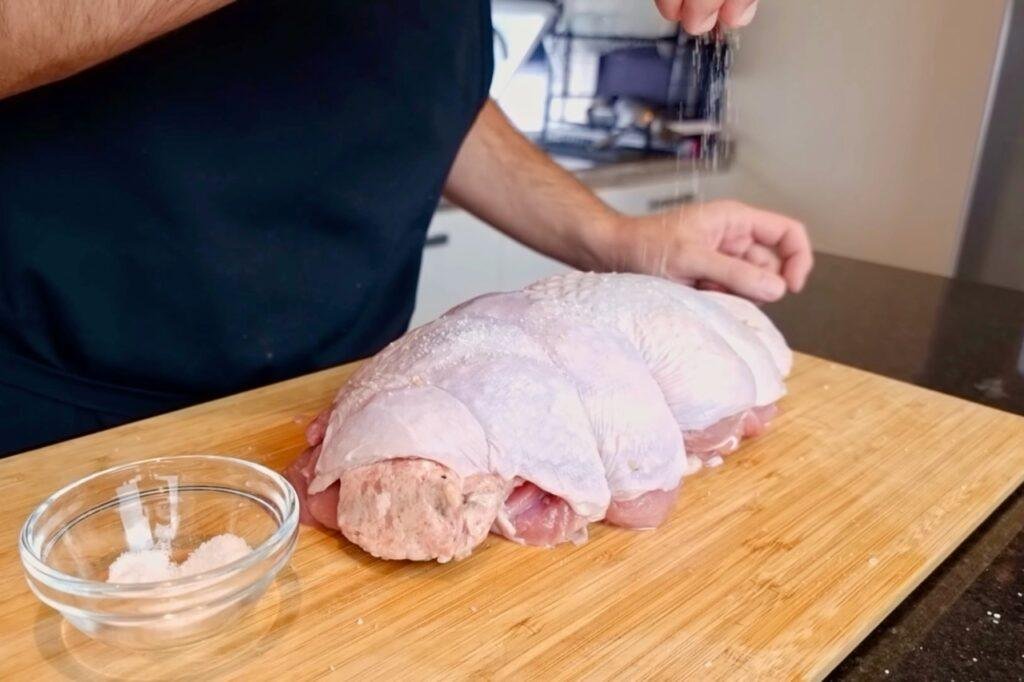
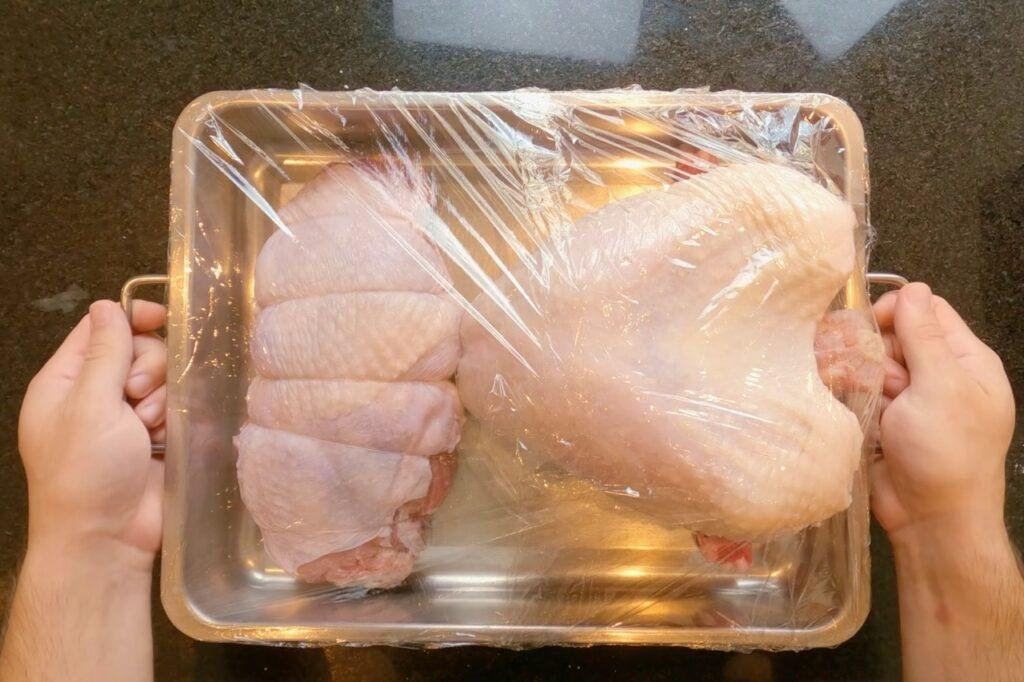
Lift the skin from the neck end, sprinkle in a few pinches of the 12 g of salt and rub it gently into the meat. Flip the crown over and season the underside lightly, then season the outside of the skin. Use less on the stuffed leg, because the stuffing is already seasoned, and cover the outside all the way round. Refrigerate the crown and leg, covered, for 24 to 72 hours.
Roast, Baste and Rest
On the day, work backwards from your eating time using the table below. Take the turkey out of the fridge 60 minutes before it goes into the oven. Preheat the oven to 180°C (355°F) fan assisted, or 200°C (390°F) with no fan.
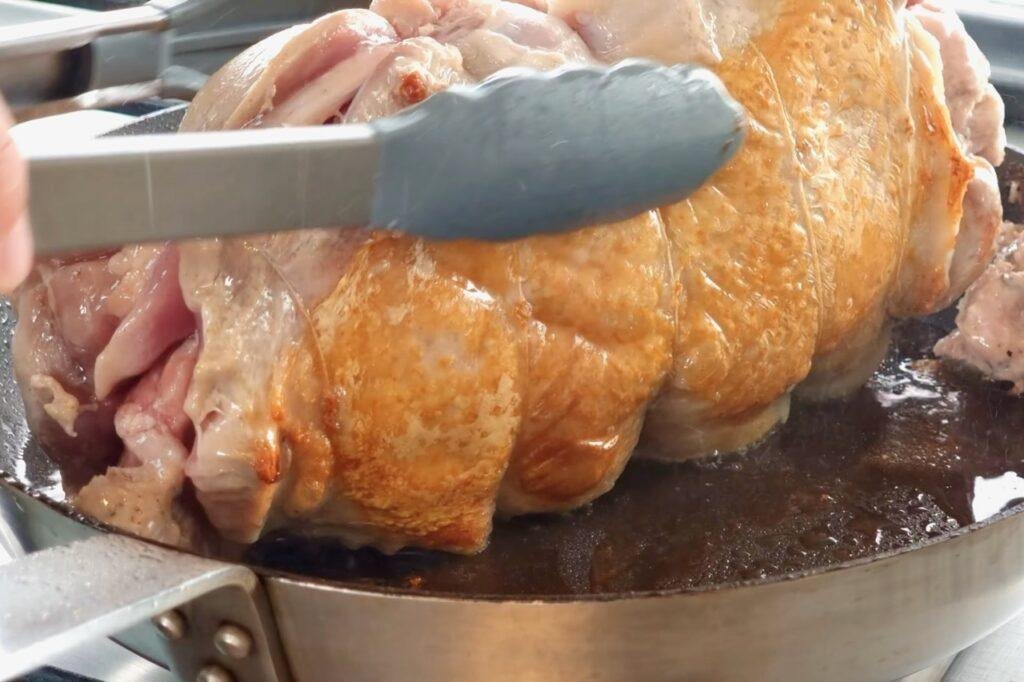
Brown the stuffed leg first. Heat a large frying pan over a medium heat for 2 minutes, add a splash of oil and turn the leg regularly until it is evenly golden all the way round. It took me about 15 minutes.
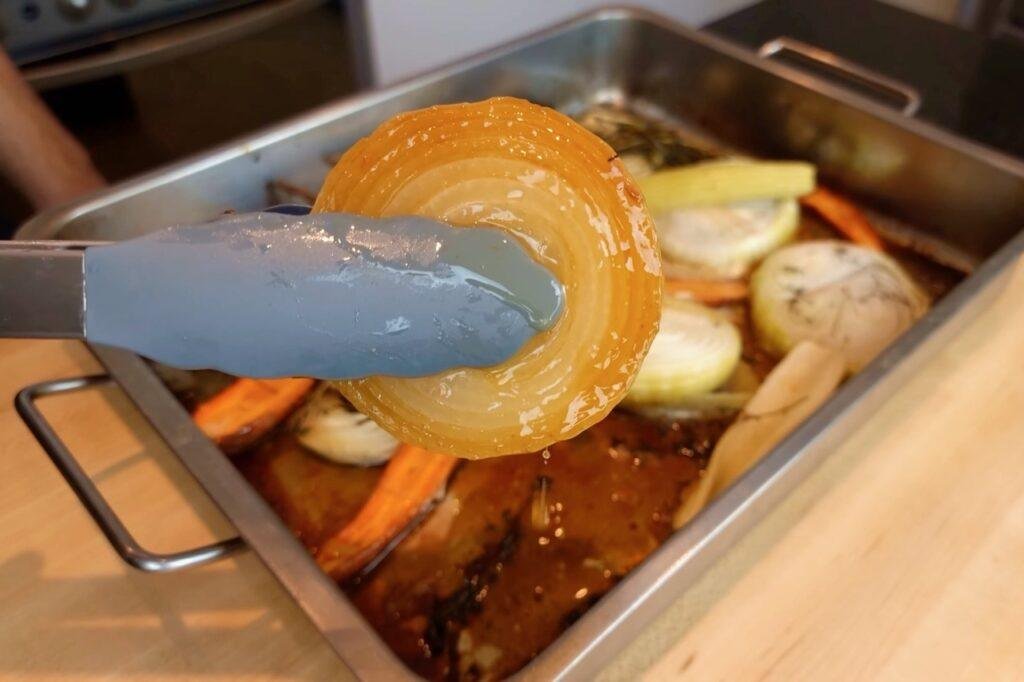
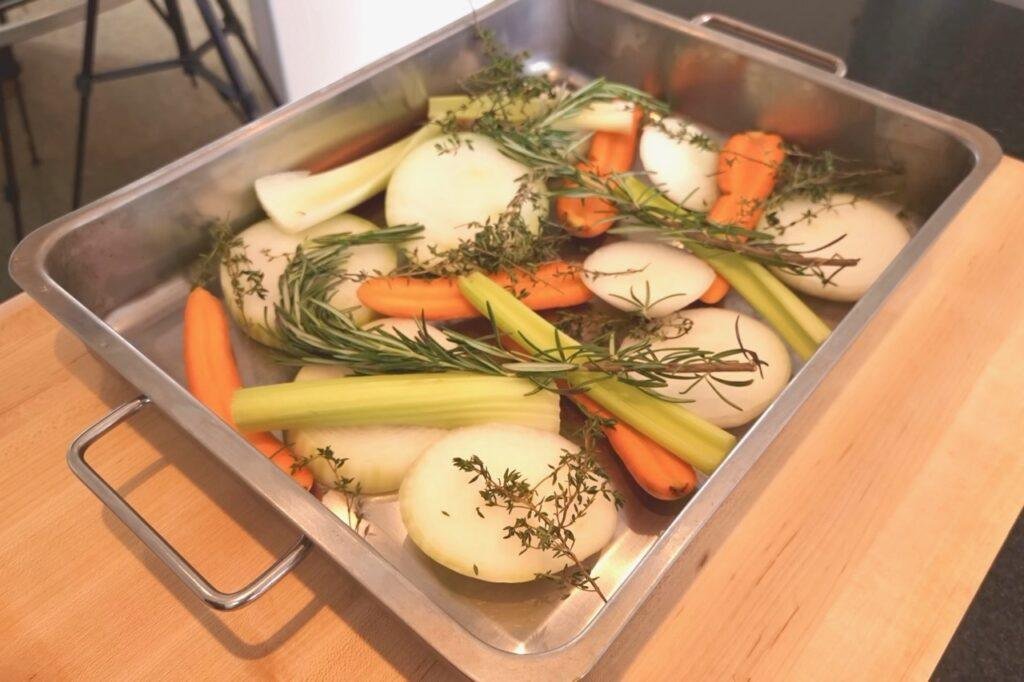
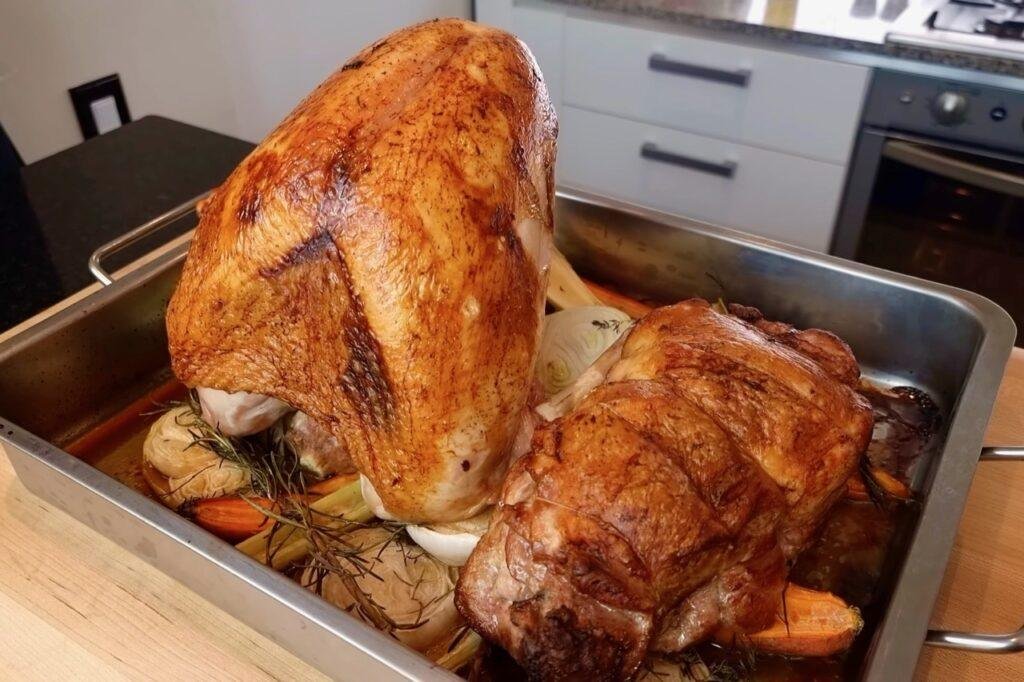
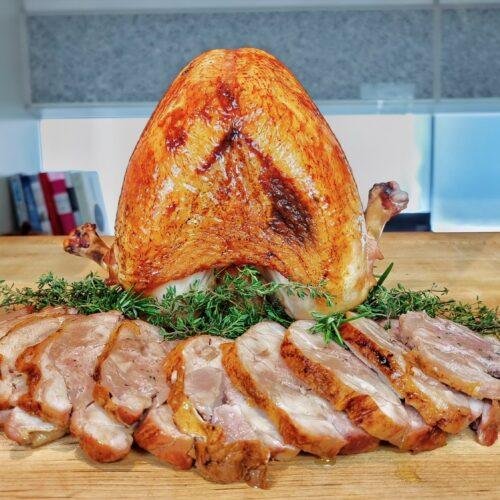
Put the sliced onions, carrots, celery, rosemary and thyme in the roasting tray as a trivet. It keeps the meat off the base of the tray and makes a delicious base for gravy. Sit the crown and the stuffed leg on top. For a more golden, crisper skin, you can also slide a few slices of butter under the skin of the crown. Start the crown with the cavity facing down so the butter melts evenly across the breast.
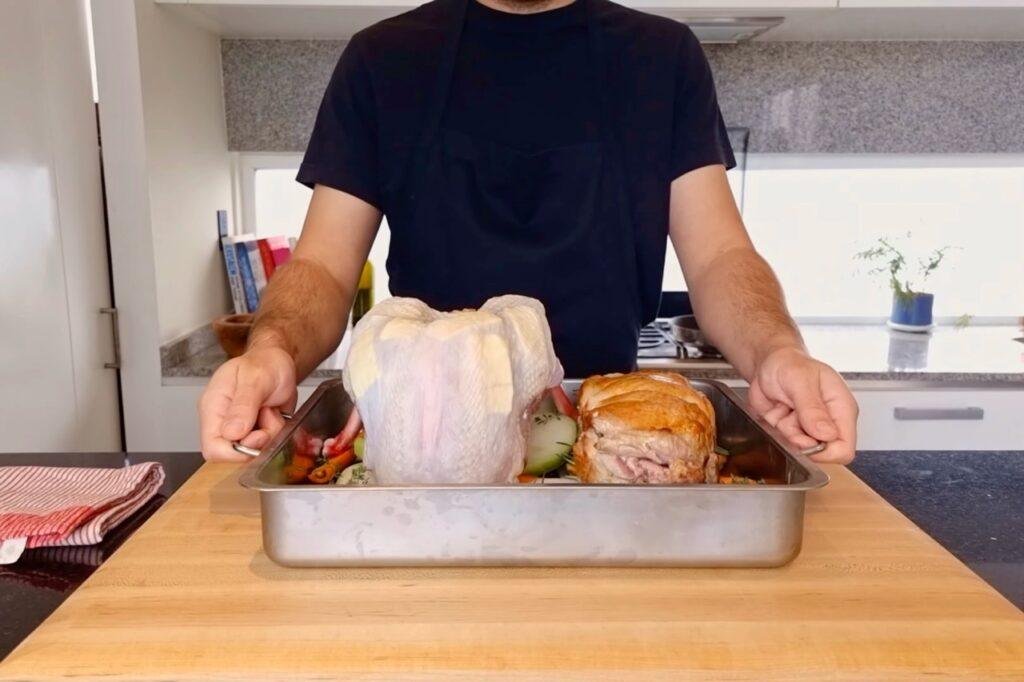
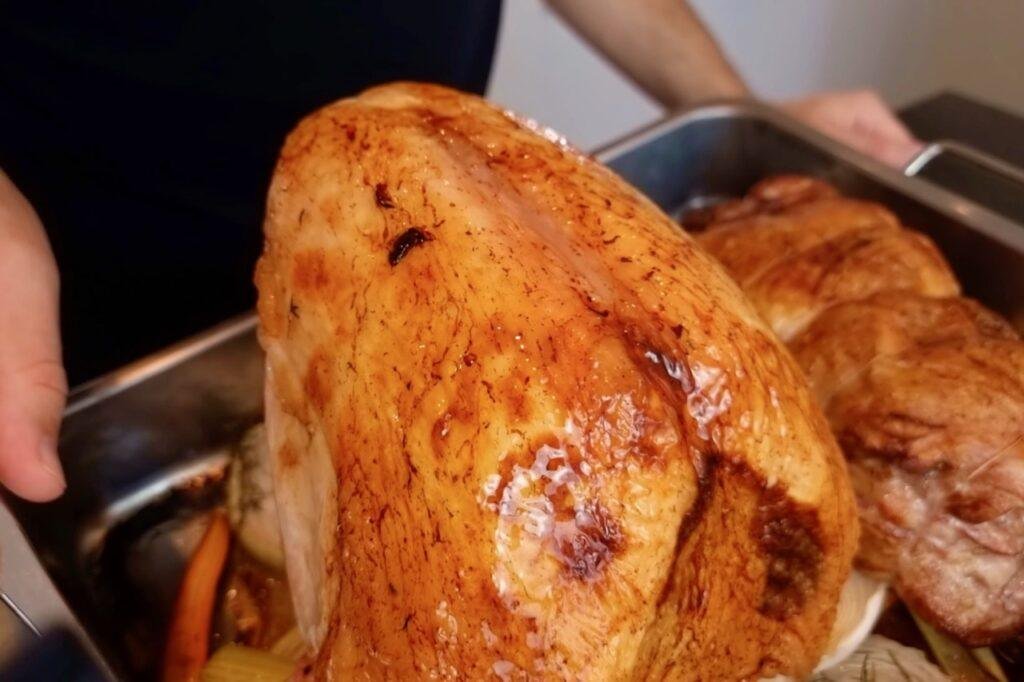
Roast for the time in the table, which is 2 hours for a 2.5 kg crown. Baste three times with a serving spoon, at 30 minute intervals, and flip the crown up onto its wing joints at the first baste. At the third baste, about three quarters of the way through, check the leg and the crown with a meat thermometer. Mine read 71.4°C (160°F) in the leg and 70°C (158°F) in the crown, and I wanted both a little higher.
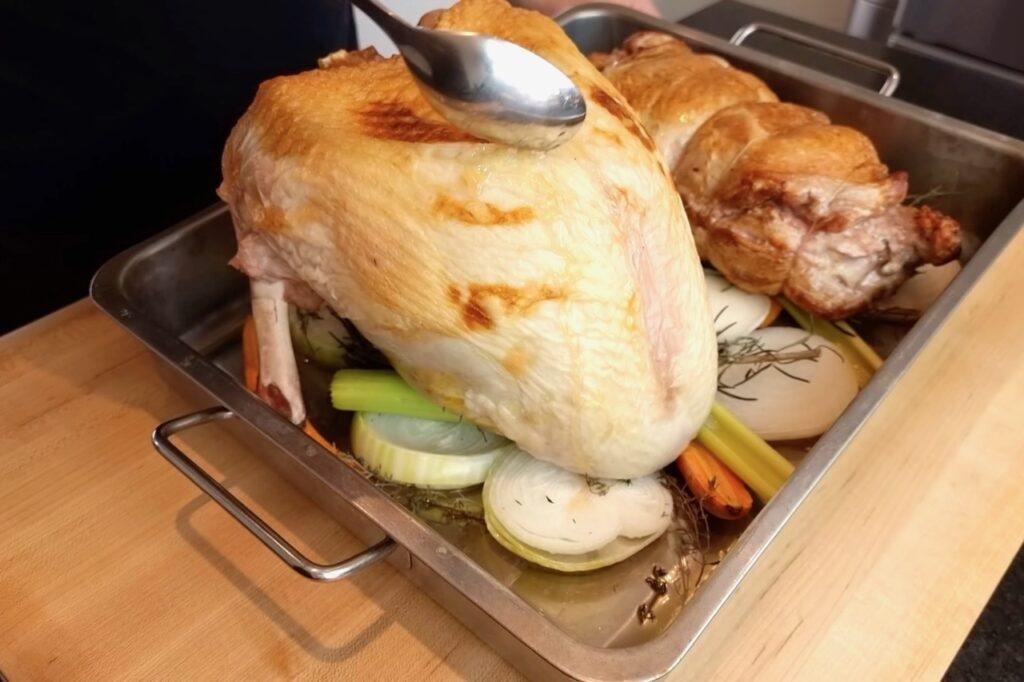
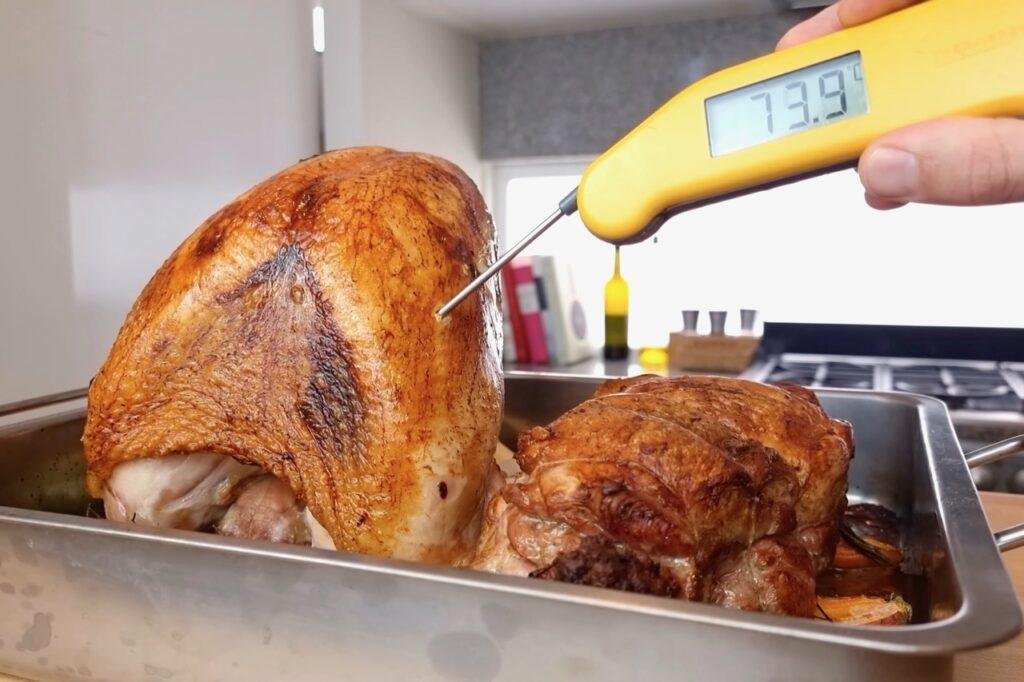
Stab the meat once only and go back into the same hole, because the juices run out of any holes you make. Thirty minutes later my crown read 74°C (165°F), which is ready, as it rises to around 80°C (176°F) while it rests. The leg is more forgiving because of its intramuscular fat, so anything above 76°C (168°F) is good.
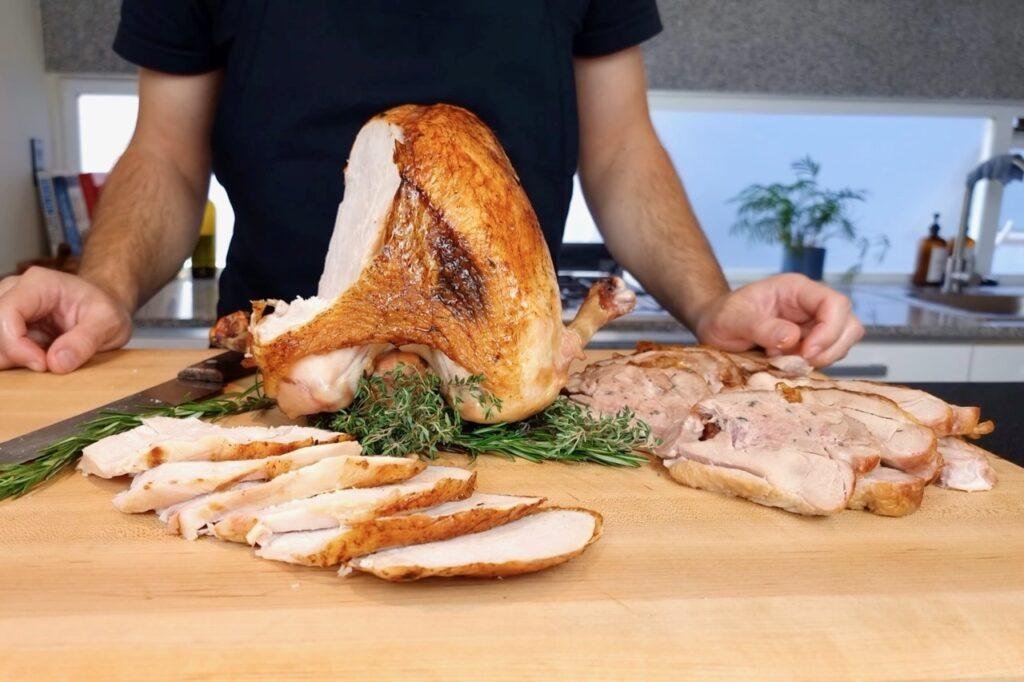
Rest the turkey covered in foil for at least half the cooking time and up to the whole cooking time. The meat holds its heat for a very long time under the foil, and the rest gives you time to get everything else hot to the table, with juicier, more tender meat. That window is when I slide a tray of my plump, juicy roasted carrots into the empty oven.
Turkey Cooking Times
Use the weight of your turkey crown. The cook times are the same at 180°C (355°F) fan assisted and 200°C (390°F) with no fan. Take the turkey out of the fridge 60 minutes before it goes into the oven.
| Weight of turkey crown | Cook time (minutes) | Rest time (minutes) |
|---|---|---|
| 1.5 kg / 3.3 lb | 100 | 50 |
| 2.0 kg / 4.4 lb | 110 | 55 |
| 2.5 kg / 5.5 lb | 120 | 60 |
| 3.0 kg / 6.6 lb | 130 | 65 |
| 3.5 kg / 7.7 lb | 140 | 70 |
| 4.0 kg / 8.8 lb | 170 | 85 |
| 4.5 kg / 9.9 lb | 180 | 90 |
| 5.0 kg / 11 lb | 190 | 95 |
| 5.5 kg / 12.1 lb | 200 | 100 |
| 6.0 kg / 13.2 lb | 210 | 105 |
| 6.5 kg / 14.3 lb | 220 | 110 |
| 7.0 kg / 15.4 lb | 230 | 115 |
| 7.5 kg / 16.5 lb | 240 | 120 |
| 8.0 kg / 17.6 lb | 250 | 125 |
To work out your timings, subtract the rest time, the cook time and 60 minutes from the time you want to eat. For a 2.5 kg (5.5 lb) crown on the table at 3 pm, that is 1 hour of rest, 2 hours of cooking and 1 hour out of the fridge, so the turkey comes out of the fridge at 11 am. My stuffed leg weighed 1.4 kg (3.1 lb). It may cook a little quicker than the crown, but it should be roughly the same.
Tips for the Best Turkey
- Taste a mini burger of the stuffing before you stuff the legs, so you can fix the seasoning.
- Go slowly when freeing the skin from the meat, because a torn skin will not crisp evenly.
- Stab the meat with the thermometer once only and use the same hole each time.
- Take the crown out at 74°C (165°F), because it rises to around 80°C (176°F) as it rests.
- Rest the turkey covered in foil for at least half the cooking time.
Pork, Sage and Thyme Stuffing
Equipment
- Chopping board
- Knife (general) boning knife or any non-serrated knife
- Frying pan
- Mixing bowl / Bowl
Ingredients
- 500 g pork mince 80/20, 17.6 oz
- 1/2 white onion finely diced
- 2 stems sage leaves picked and chopped
- 1 small bunch thyme leaves picked
- 2 tablespoons breadcrumbs
- 1 g salt
- 0.5 g black pepper cracked
- 15 ml cooking oil for sweating the onion
Instructions
- Dice the onion finely. Place a frying pan over a low heat, add the cooking oil, the diced onion and a pinch of salt, and sweat gently until the onion is translucent and smells sweet. Tip it onto a plate or tray to cool.
- Pick the sage leaves off the stalks, roll them into a cigar and run your knife through them once only. Pull the thyme leaves from the stalks by running your fingers from top to bottom.
- In a mixing bowl, combine the pork mince, breadcrumbs, sage and thyme. Add the cooled onion, the salt and the cracked black pepper, and mix gently. Rough handling toughens the meat.
- Flatten a pinch of the mix into a mini burger and fry it in the pan for 2 minutes until cooked through. Taste it and add more salt to the mix if it needs it.
- Cover the bowl and chill it in the fridge until you are ready to stuff the turkey legs.
Video
Nutrition
Nutrition Facts
| Total Fat | 10.1g |
| Saturated Fat | 3.4g |
| Cholesterol | 30mg |
| Sodium | 64.1mg |
| Total Carbohydrate | 1.6g |
| Dietary Fiber | 0.3g |
| Sugars | 0.3g |
| Protein | 7.3g |
| Potassium | 134.7mg |
Best Way to Cook a Turkey: Juicy, With Cooking Times
Equipment
- Chopping board
- Knife (general) boning knife or any non-serrated knife
- Baking / Roasting tray
- Frying pan
- Mixing bowl / Bowl
- Tongs
- Kitchen string oven-safe: five 50 cm / 20 inch lengths, 100% cotton, uncoloured and unbleached
- Thermometer / Probe
- Serving spoon
Ingredients
Turkey and dry brine
- 6.5 kg whole natural unseasoned turkey 14.3 lb, boned as in the method
- 12 g salt for the dry brine
- 30 g butter optional, sliced, for under the crown skin
- cooking oil a splash, for browning the leg
Stuffing
- 1 batch Pork, Sage and Thyme Stuffing see the stuffing recipe
Trivet
- 2 white onions sliced into discs
- 3 carrots sliced in half
- 2 celery sticks
- 2 stalks rosemary
- 2 handfuls thyme
Instructions
Bone the turkey and stuff the legs
- Make an incision in the skin between the legs and the body. Hold the turkey up by one leg and slice around the joint between the thigh and the body to take off the whole leg in one piece. Repeat with the other leg.
- Debone each leg. Lay it skin side down and feel for where the two long bones run. Slice along them until you hit bone, then work around both sides until they are mostly exposed.
- Pierce the knife under the drumstick bone and slice towards where the foot was. Lift the leg by the exposed bone and slice down it to free it from the meat. Repeat with the thigh bone, slicing out towards where the body was, then lift the leg by the free end and slice down until the meat is completely off the bone.
- Feel for bone fragments and cartilage. Slice out the cartilage around the knee joint without cutting through the skin on the other side, and slice out the thin, toothpick-like bones in the drumstick. Repeat with the other leg.
- Lay five 50 cm / 20 inch lengths of oven-safe string evenly spaced on a chopping board. Place one leg on the strings with the widest part of the meat at the top. Slice out the highest point of the meat and place it in the empty patch where the knee cartilage was.
- Lay the stuffing in a cylinder down the middle of the leg. Slice the high point out of the second leg in the same way, then lay that leg on top, skin side up, with its widest part at the opposite end to the first leg. Shape the meat into an even cylinder.
- Tie the second piece of string with a left over right knot, looped one extra time and pulled tight, then add another left over right knot to lock it. Tie the fourth, third, first and fifth strings in that order, which keeps the shape even. Trim off the excess string.
- Make the crown. Hold the bird up by one wing and, halfway between the first wing joint and the joint on the body, slice through and run the knife 360 degrees around the bone. Bend the wing back until the joint dislocates and comes free. Repeat with the other wing.
- Turn the body 90 degrees and slice off the rear section: find the gap in the spine and push the knife through. What is left is the crown. Keep the bones to make a stock for gravy.
- Optional: remove the wishbone to make carving easier. Feel for the bone on either side of the neck opening, pierce the knife in behind it and out the other side, and cut firmly down through it. Do the same on the other side, slice up towards where the two bones meet, then grip the bone and twist it free.
- From the neck end, gently work your fingers between the skin and the meat to free it. This lets air in for crisper, golden skin. Go slowly so you do not tear the skin. Trim off any excess skin at the neck end, leaving a little extra for shrinkage.
Dry brine
- Lift the skin from the neck end, sprinkle in a few pinches of the salt and gently rub it into the meat. Flip the crown upside down and season the underside a little, then season the outside of the skin.
- Season the outside of the stuffed leg all the way around with the rest of the salt. Use less on the leg than on the crown, because the stuffing is already seasoned.
- Refrigerate the crown and the stuffed leg, covered, for 24 to 72 hours.
Roast the turkey
- Work backwards from your eating time using the cooking times table in the post: subtract the rest time, the cook time and 60 minutes for the turkey to come out of the fridge. For a 2.5 kg / 5.5 lb crown to be on the table at 3 pm, take it out of the fridge at 11 am.
- Heat a large frying pan over a medium heat for 2 minutes. Add a splash of cooking oil and brown the stuffed leg, turning it regularly, until it is evenly golden all the way around. This took about 15 minutes.
- Preheat the oven to 180°C / 355°F fan assisted, or 200°C / 390°F with no fan.
- Put the sliced onions, carrots, celery, rosemary and thyme in the roasting tray to make a trivet. Place the crown and the stuffed leg on top. Optionally, slide slices of butter under the skin of the crown. Start the crown with the cavity facing down. Once the turkey has been out of the fridge for 60 minutes, put the tray in the oven.
- Roast for the time in the table, which is 2 hours for a 2.5 kg crown. Baste the meat with a serving spoon three times, at 30-minute intervals. At the first baste, turn the crown up so it sits on the wing joints.
- At the third baste, around three quarters of the way through, check the stuffed leg and the crown with a meat thermometer to see how much longer they need. Stab the meat only once and use the same hole each time, because juices run out of any holes you make. At this stage the leg was 71.4°C / 160°F and the crown 70°C / 158°F, and I wanted both a little higher.
- The crown is ready at 74°C / 165°F and will rise to around 80°C / 176°F as it rests. The leg meat is more forgiving because of its intramuscular fat, so anything above 76°C / 168°F is good.
- Rest the turkey, covered in foil, for at least half the cooking time and up to the whole cooking time. The rest time for your crown is in the table. The meat holds its heat for a very long time under the foil, and the rest gives you time to get everything else to the table.
Video
Notes
Nutrition
Nutrition Facts
| Total Fat | 42.5g |
| Saturated Fat | 12.8g |
| Cholesterol | 310mg |
| Sodium | 717.4mg |
| Total Carbohydrate | 1.6g |
| Dietary Fiber | 0.3g |
| Sugars | 0.3g |
| Protein | 99.8g |
| Potassium | 1297.3mg |
What to Serve With This Turkey
Roast potatoes are the obvious partner, and my roast potato method works with any variety. Oven space is tight on Christmas Day, so pair the turkey with sides you can make ahead, like braised red cabbage, leek gratin and charred Brussels sprouts.
Frequently Asked Questions
How many hours does it take to cook a turkey?
A 2.5 kg (5.5 lb) crown with the stuffed leg takes 2 hours at 180°C (355°F) fan assisted or 200°C (390°F) with no fan, followed by a 60 minute rest. Bigger crowns take longer, up to 250 minutes for 8 kg (17.6 lb), so check the table above. Take the turkey out of the fridge 60 minutes before it goes in.
What is the secret to a moist turkey?
It is a few things working together. Dry brine for 24 to 72 hours, break the bird down so it roasts for less time, and rest it covered in foil for at least half the cooking time. The leg meat has intramuscular fat, so it stays moist more easily than the breast.
What oven temp is best for turkey?
Use 180°C (355°F) in a fan assisted oven or 200°C (390°F) in an oven with no fan, and keep it there for the whole cook. The crown is ready at 74°C (165°F), and the leg is good above 76°C (168°F).
How often should I baste my turkey?
Baste three times, at 30 minute intervals, using a serving spoon. In a 2 hour roast the third baste falls about three quarters of the way through, which is the moment to check the temperature of the leg and crown with a meat thermometer.
What side goes down when roasting a turkey?
Start the crown with the cavity facing down, so the butter melts evenly across the breast meat. At the first baste, flip it up so it sits on the wing joints for the rest of the cook.
What to put in the bottom of a roasting pan for turkey?
Make a trivet from sliced onions, carrots, celery, rosemary and thyme, and sit the crown and stuffed leg on top. It keeps the meat off the base of the tray and makes a delicious base for gravy.